
Why Time Beats Timing
The Market Rewards Patience, Not Predictions

You’ve probably wondered:
“Should I wait for the next dip before investing?”
Or: “What if I buy right before a crash?”
It’s a perfectly human instinct—nobody wants to lose money.
But here’s the truth: trying to time the market is far more dangerous than staying in it.
The Problem With Market Timing
The idea of jumping in and out of the market sounds smart in theory.
Buy low, sell high—what could go wrong?
As it turns out: everything.
Even the pros—armed with PhDs, Bloomberg terminals, and full-time risk teams—routinely fail at timing the market. If they can’t do it reliably, it’s unlikely any of us can.1
But the real issue isn’t just that market timing is hard.
It’s that the market’s biggest gains tend to happen in just a few unpredictable days.
What Happens If You Miss Just a Few Days?
I ran the numbers.
Using daily S&P 500 data from 1988 to 2025, I looked at what would happen if you:
Stayed fully invested all year
Missed the 10 best days in the market
Missed the 20 best days
I looked at two versions of the S&P 500:
The Price Index, which reflects changes in share prices only, excluding dividend reinvestment
The Total Return Index, which includes dividends and assumes they’re reinvested
While this analysis is based on U.S. data, the lesson applies globally.
Missing just a handful of the best days—whether in the UK, Europe, or the U.S.—can devastate long-term results.
These rare, oversized gains often happen when most investors are sitting on the sidelines.
Here’s what the average annual returns looked like over nearly four decades2
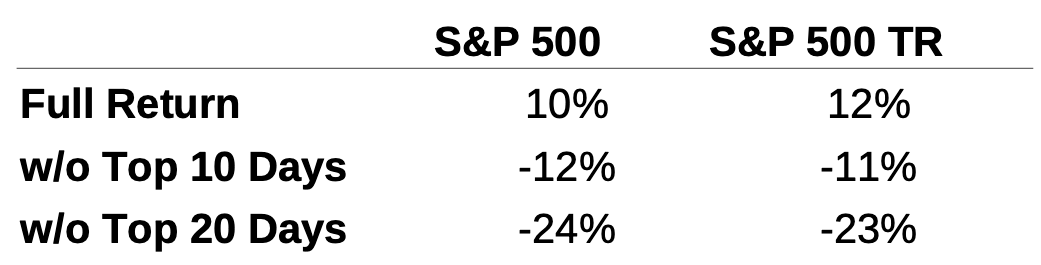
As you can see, missing just the 10 best days doesn’t just reduce your returns—it flips them into losses.
And missing the top 20? That turns a long-term investment strategy into a complete failure.
It’s a brutal reminder: the cost of being out of the market—even briefly—can be enormous.
The Catch: You Can’t Predict the Best Days
And here is where it gets critical:
Some of the market’s biggest gains don’t happen during calm periods.
They often come right after sharp drops—when fear is high and many investors are sitting in cash.
Over the past 35+ years, I looked at the 10 and 20 best market days in each calendar year.
On average, 8 of the top 10, and nearly 15 of the top 20, occurred within just 10 trading days of one of the year’s 20 worst days.
That might sound like a strategy: just invest during downturns.
But that’s the trap.
Not every decline is followed by a rebound.
Some keep falling. Others flatline. And there's no signal to tell you which is which.
To catch the best days, you have to stay invested through the worst.
So What Should You Do Instead?
Forget timing.
Instead:
Stay consistent
Keep investing regularly
Stick to the plan
You don’t need to be a genius.
You just need to be there when the market turns in your favour.
In investing, consistency beats cleverness. Time in the market almost always beats timing the market.
If you missed last week's post, I showed how simply investing $500 a month—without trying to “beat the market”—can still build serious long-term wealth.
Read: What $500 a Month Could Become
Coming Soon
In next week’s post, I’ll explore:
Why AI Trading Doesn’t Work for Most Investors (And What to Do Instead)
Until then, stay invested—and stay curious.
Subscribe to The Practical AInvestor to get posts and tools straight to your inbox:
According to the S&P Dow Jones Indices SPIVA Scorecard, nearly 90% of U.S. large-cap mutual funds underperformed the S&P 500 over the past 15 years. Similar results have been observed in Europe and the U.K. Even professional fund managers rarely outperform the market consistently.
Based on daily returns from 1988 to 2025 for the S&P 500 and S&P 500 Total Return indices. Assumes a passive investor who missed only the best-performing days in each year.